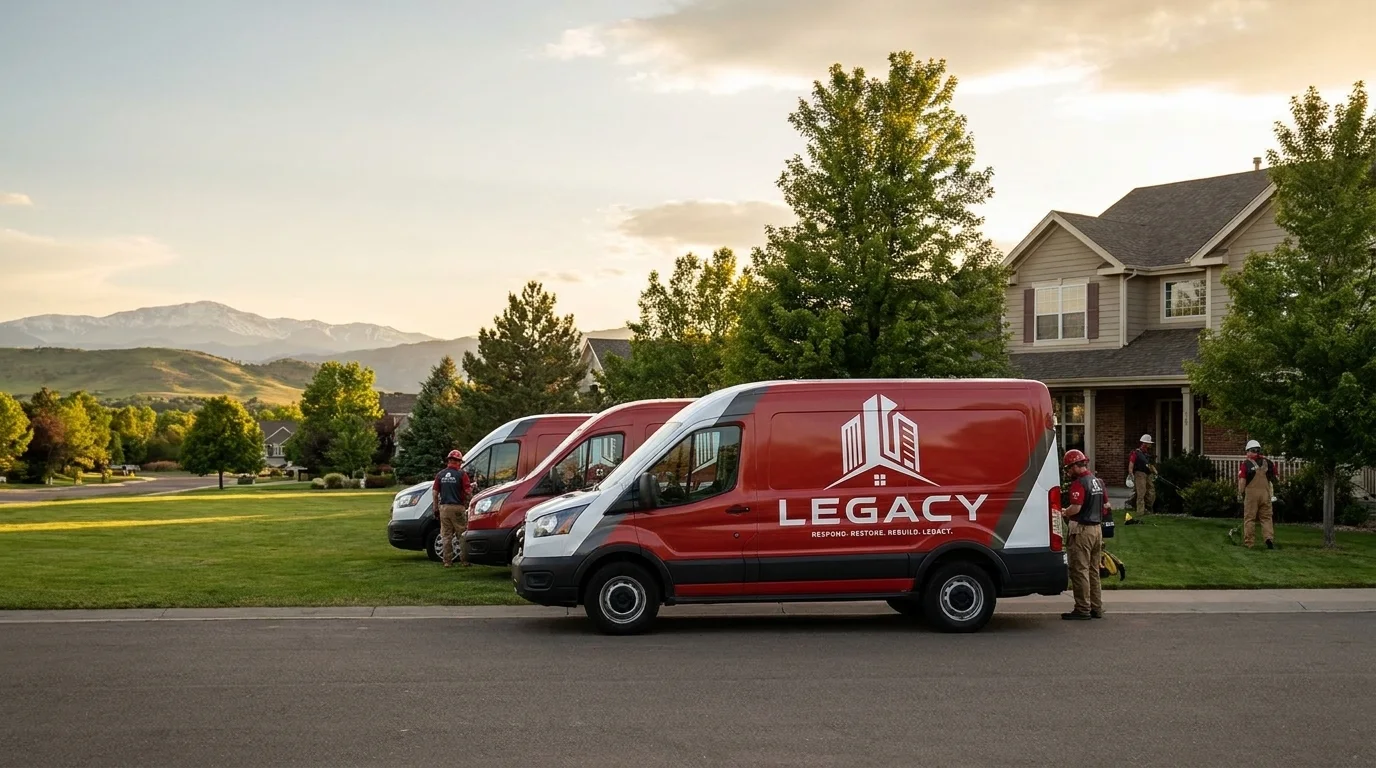
24/7 Emergency Water Damage Restoration in Denver
24/7 emergency water damage restoration in Denver and surrounding areas. IICRC-certified, insurance billing accepted. Call (888) 249-5867.
Water damage emergency in Denver? Call now, we answer 24/7. A supply line failure, a sewer backup, or a roof leak during a spring hailstorm all start the same clock: water that isn’t extracted within the first 24 to 48 hours starts breaking down drywall, delaminating subfloor, and creating the moisture conditions mold needs to colonize. Legacy Resto llc handles the extraction and structural drying side of that clock, from the first wet-vac pass to the final moisture reading that lets you close out the claim.
What Water Damage Restoration actually involves
Water damage restoration is not just pulling standing water off a floor. It’s identifying how deep moisture has traveled into building materials, whether the water is clean, gray, or contaminated, and then drying the structure to a verified dry standard, not just a visibly dry one. A hardwood floor can look fine on the surface while the subfloor underneath stays saturated for days, quietly warping and feeding mold growth behind baseboards.
On a typical job this means commercial-grade extraction equipment, air movers positioned to create cross-flow drying patterns, and dehumidifiers sized to the cubic footage of the affected space, not just the square footage. Category 2 water (washing machine overflow, dishwasher discharge) and Category 3 water (sewage backup, flooding from outside the home) require containment and different handling than a clean water line break, which is one reason the category of water gets documented before drying begins, not after.
Our process
- Moisture assessment and category classification. We use moisture meters and thermal imaging to map how far water has traveled into walls, flooring, and subfloor, and classify the water category, which determines the extraction and PPE protocol.
- Water extraction. Truck-mounted or portable extraction units remove standing and trapped water from flooring, carpet pad, and cavities before drying equipment goes in. This step alone can remove hundreds of gallons on a flooded basement.
- Structural drying. Air movers and dehumidifiers are placed according to the drying chamber, not guessed at. For Category 2 or 3 losses, we set up containment barriers to keep contaminated air and materials isolated from unaffected parts of the home.
- Moisture monitoring. We return to take daily or every-other-day moisture readings on affected materials, adjusting equipment placement until readings hit dry standard, not until the equipment has run for a set number of days.
- Documentation for your claim. Photos, moisture logs, and equipment run-time records go into the file your adjuster reviews, which is often what determines how smoothly the claim processes.
What separates a good water damage response from a bad one
The most common mistake is pulling drying equipment too early because a surface feels dry to the touch. Drywall and subfloor hold moisture well below what a hand can detect, and if equipment comes out before the material hits dry standard on a meter, mold can start within 24 to 72 hours in the wall cavity nobody’s checking anymore.
Another gap: skipping the moisture map at the start. Without a documented baseline, there’s no way to prove the structure actually reached dry standard, which matters if a mold claim comes back months later and the insurance carrier asks whether the original drying job was done to spec. Adjusters generally want to see IICRC S500-standard documentation, equipment run-time logs, and category classification on file, not just a before-and-after photo.
Cutting corners on containment is the other one. If Category 3 water isn’t contained properly, cross-contamination can spread contaminated material into rooms that were otherwise untouched, turning a one-room job into a much larger scope.
What does Water Damage Restoration cost?
Costs vary with the category of water, how far it traveled, and how many building materials have to be removed versus dried in place. Every loss is different, which is why Legacy Resto llc provides a written scope of work before any work begins, not a verbal estimate. Homeowners insurance typically covers water damage restoration when the loss is sudden and accidental, such as a burst pipe or appliance failure, though coverage for gradual leaks or flooding from outside the home often depends on the specific policy.
| Scenario | Typical range |
|---|---|
| Single room, clean water, no material removal | $1,200 - $3,500 |
| Multi-room clean water with carpet/pad extraction | $3,000 - $7,000 |
| Category 2 water with partial drywall removal | $4,500 - $9,000 |
| Basement flooding, standing water over 2 inches | $6,000 - $15,000 |
| Category 3 water requiring containment and demolition | $8,000 - $20,000+ |
Seasonal & regional considerations
Denver’s freeze-thaw cycles are a leading cause of winter pipe failures, especially in older homes with pipes running through uninsulated crawl spaces or exterior walls. A pipe that freezes overnight and thaws by midday can split and release water into wall cavities before anyone notices, since the leak often shows up hours after the actual freeze event. Spring and summer bring a different pattern: hailstorms and heavy downpours that overwhelm roof flashing or window seals in older housing stock, pushing water into attics and upper-floor ceilings rather than basements.
Service area
Legacy Resto llc provides water damage restoration throughout Denver, including older neighborhoods with original plumbing and newer construction with finished basements, both of which bring their own drying challenges.
If water is actively spreading through your home right now, don’t wait on the drying clock. Schedule your moisture assessment with Legacy Resto llc and get extraction equipment on-site before the damage spreads further into your walls and subfloor.
Frequently Asked Questions
Does homeowners insurance cover water damage restoration?
How long does structural drying typically take?
What's the difference between Category 1, 2, and 3 water?
Can I stay in my home during water damage restoration?
What should I do while waiting for a water damage crew to arrive?
Looking for the best water damage restoration company in Denver?
Legacy Resto llc provides licensed and insured water damage restoration in Denver, Colorado and the surrounding area, and has served local property owners since 2022. We answer calls 24/7 — call (888) 249-5867 for immediate help.
Need Water Damage Restoration now?
We respond 24/7 across Denver and surrounding Colorado cities.
Related Coverage
- Our Restoration Services
- Contact Legacy Resto llc
- 24/7 Emergency Water Removal & Cleanup in Denver
- 24/7 Emergency Water Cleanup in Denver
- Burst Pipe Emergency Checklist: Step-by-Step Response
- What To Do in the First 24 Hours After Water Damage
- How To Choose a Restoration Company in Denver (Without Getting Burned)